October 13, 2026 · 5 min read
AI images on TikTok Shop: what the policy allows
TikTok Shop published its rules for AI-generated listing images in September 2026. The policy is not a ban. It draws one line, and it is the same line a careful seller would draw anyway: the image has to be the product the buyer receives.
By Smit Golakiya · Founder, BrandShots
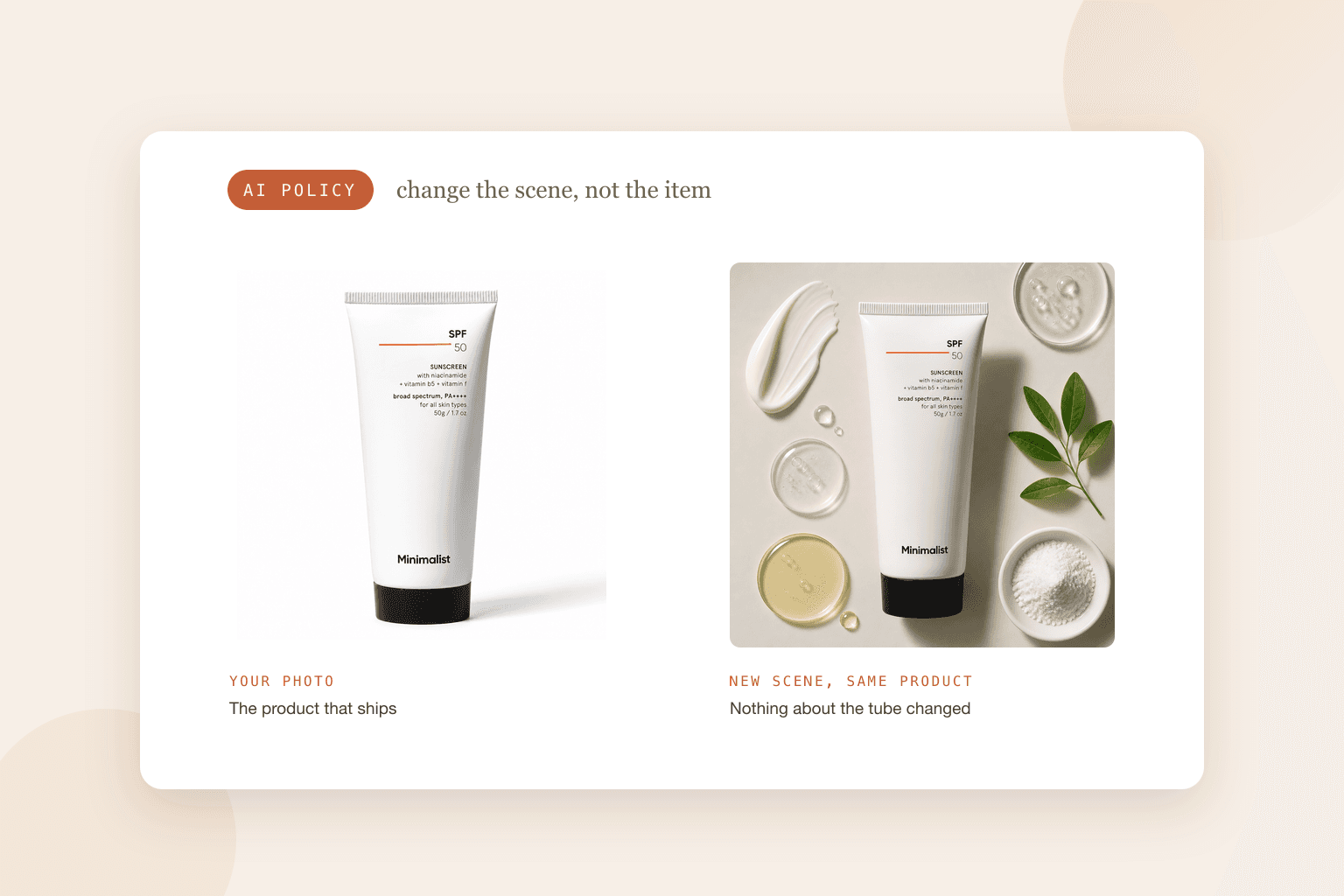
Short answer: TikTok Shop allows AI-generated and AI-edited listing images, as long as the product in the image is the product the buyer receives. The policy, published on 24 September 2026 for the United States, says the goal is not to discourage AI content but to stop misleading product displays. Changing a product's size, color, shape, material, features or quantity is what it rules out. Cleaning a background, lighting a product properly and building a styled scene around a real photo are not on the banned list.
Amazon's position took years to arrive and is still spread across several documents. TikTok's arrived in one page, and it is more specific than anything Amazon has published.
What the policy actually says
TikTok's requirement document opens by saying the goal is not to discourage AI-generated content entirely, but to prevent misleading product displays where the product shown does not match the product being sold.
The rule that follows from that is short: AI images must never change a product's size, color, shape, features or performance so that it no longer matches the real product.
The specific things it bans
The policy then lists the cases, which is what makes it useful:
- Changed specifications. Size, color, material or shape. Also features or performance the product does not have, and scenes that make it look more advanced, premium or functional than it is.
- Fake 3D. Flat, printed, acrylic, sticker, poster and wall-art products must not be shown as raised, layered, embossed or three-dimensional unless that is what ships. No lighting or perspective tricks to hide that an item is thin.
- Exaggerated scale. No composition, perspective, labels or reference objects that make an item look larger, taller, thicker or smaller than its stated size. Placing the product beside people, furniture or vehicles to imply false scale is called out directly.
- A different main subject. The product being sold has to be the subject. The policy's own examples: a cat toy listing using a real kitten as the main subject, or a plush robot puppy listing using a real dog.
- Wrong quantity or bundle. No showing multiple units when one ships, no implying a bundle for items sold separately, no duplicating the product in frame to inflate quantity, and no reusing one SKU's image for a different variation.
- Attributes that contradict the image. Material, volume, thickness, length and quantity have to agree with the listing. A description cannot claim silk when the attribute says cotton.
- Effects the product does not produce. No implied performance, motion or animation, and no accessories that are not included.
What stays allowed
Read against TikTok's Product Listing Policy, the permitted set is wider than people assume. Secondary images may show key features, usage scenarios, variations, styled scenes, close-ups and size comparisons. None of that is excluded by the AI rules, provided the product itself is unchanged and the scene does not imply something false.
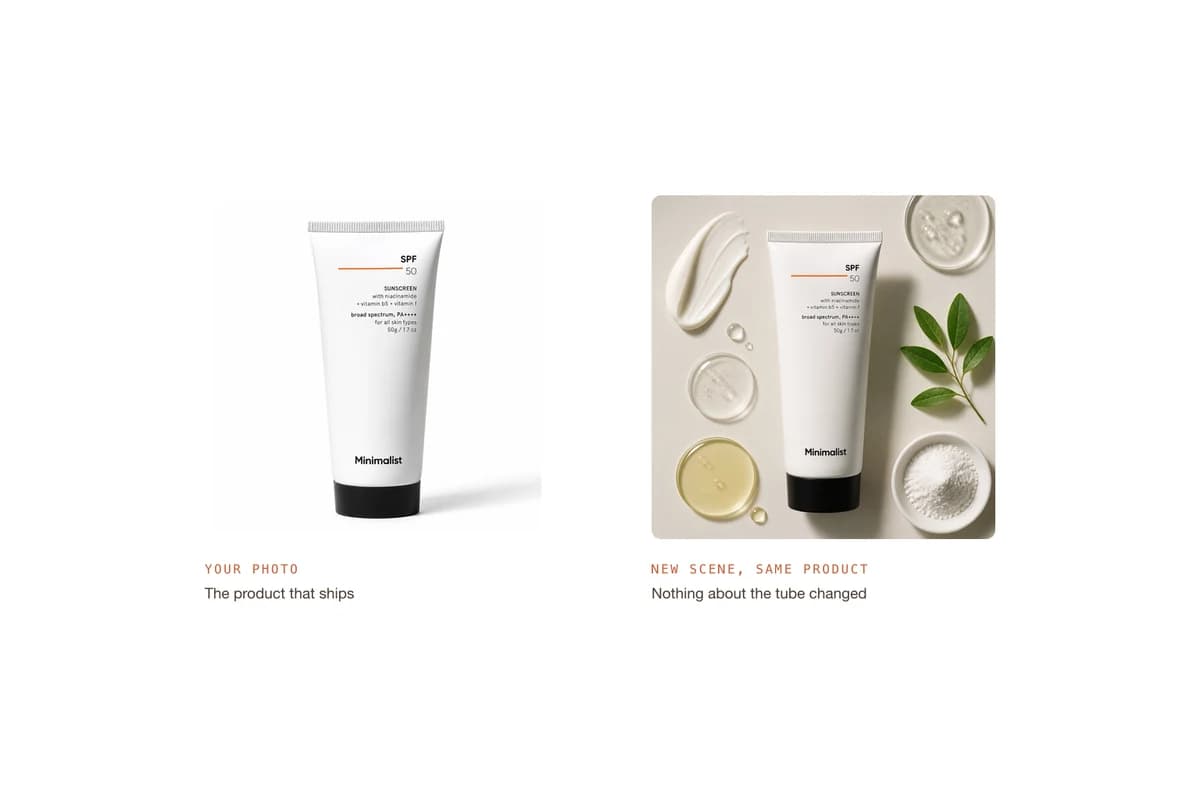
In other words: the background is yours to build, the product is not yours to edit.
How it compares with Amazon
Amazon's guidance treats AI use as a spectrum and leaves a wide middle band to judgment, which we covered in AI images on Amazon listings. TikTok skips the spectrum and lists the failure cases instead.
The practical effect is the same for an honest seller, and the compliance work is lower on TikTok, because you can check a listing against a list rather than interpret a principle. One difference worth noting: TikTok's document centers on accuracy rather than labeling, so there is no AI disclosure badge to add. Keeping the image true to the product is the requirement.
Staying on the right side of it
- Start from a photo of the real product. Everything downstream depends on it, and the policy bans renderings and placeholders outright.
- Change the scene, not the item. Backgrounds, light and props are fair game.
- Check each SKU. The policy asks that the image match the selected variation, so a shared family photo is not enough.
- Read the attributes back. If the image suggests thicker, longer or more of something than the attributes say, fix the image.
- Keep the product the subject. A beautiful scene that hides the product fails for the same reason an exaggerated one does.
That is how BrandShots is built: your photo is the source, and the model cleans, lights and stages it rather than inventing a product. Our Amazon sellers page covers the same ground for that marketplace.
Can you use AI images on TikTok Shop?
Yes. The policy permits AI-generated and AI-edited visuals and says so plainly. What it forbids is using them to show a product the buyer will not receive.
Does TikTok Shop require you to disclose AI images?
The requirement document is about accuracy rather than labeling: it asks that AI visuals match the real product, the listing attributes and the SKU. Keep your own record of which images used AI, because policies move, and this one is less than a month old.
What happens if a listing breaks the rules?
TikTok's listing policy says listings that do not meet its standards may be removed, and sellers may face enforcement including violation points or loss of selling privileges. The AI requirements sit inside that same policy framework.
This covers TikTok Shop's United States policy as published on 24 September 2026. Check Seller Center for your market before you publish.