October 27, 2026 · 8 min read
How much does product photography cost in 2026?
A white-background packshot can cost $33 or $300, depending on who takes it and what's included. Here's what product photography actually costs in 2026, from published studio rate cards, freelance rates and the hidden extras, and how it compares with shooting it yourself or using AI.
By Smit Golakiya · Founder, BrandShots
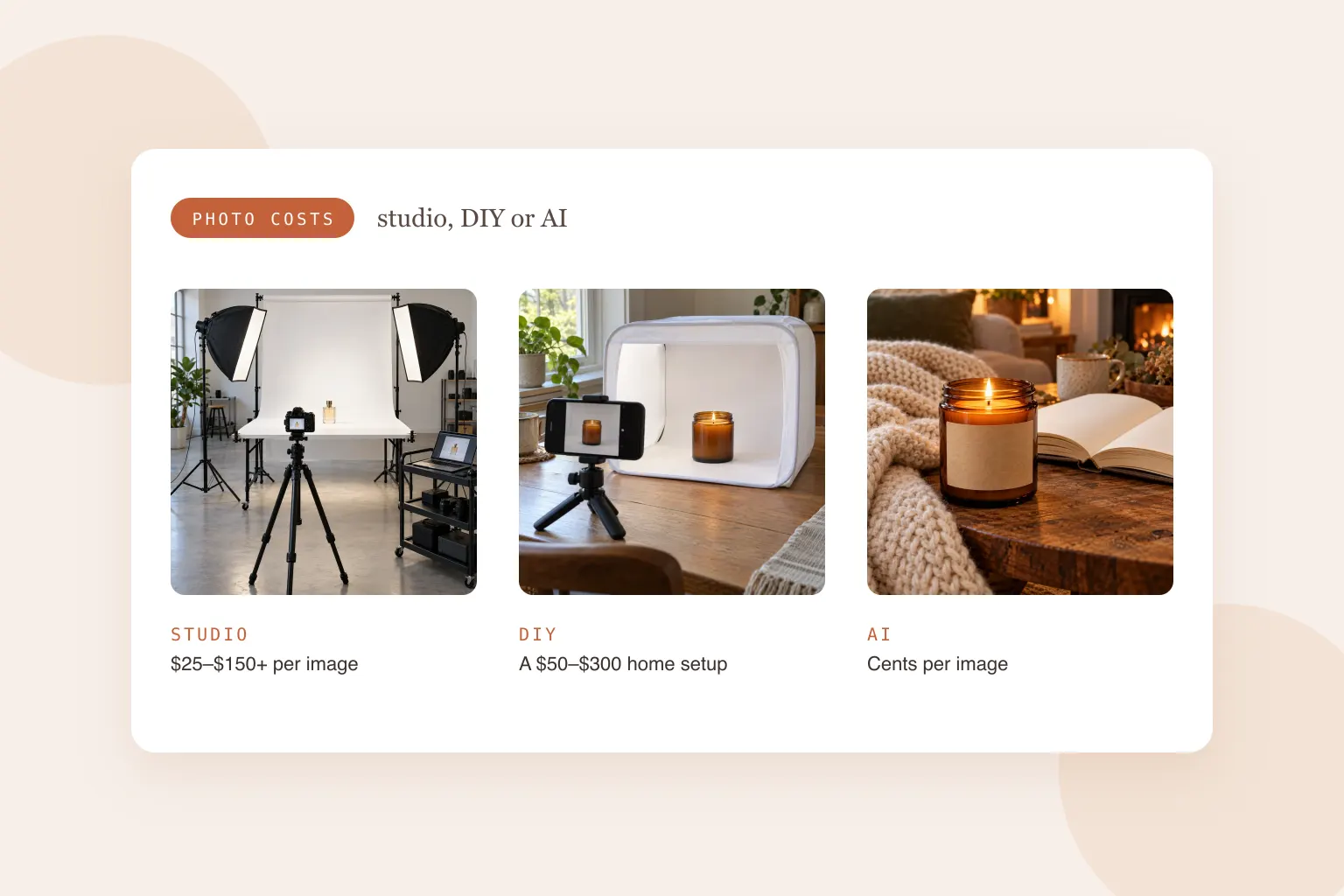
Short answer: in the US, a white-background product photo from a studio or e-commerce service costs about $25–$150 per image, with $40–$75 the most common range. Styled lifestyle images cost $100–$500 per image, and photos on a model start around $95 and often run $150–$400. A freelance photographer charges roughly $500–$3,000 a day before models, props and studio rental. Shooting it yourself costs $50–$300 for a basic home setup, and AI tools cost under $1 per image, but they still need one good photo of your product to start from.
Prices below come from studios' and services' own published rate cards and cost guides, checked in October 2026, in USD. They change often, so get a quote for your exact shot list.
Product photography cost at a glance
- Type of shot
- White-background packshot
- Typical price per image
- $25–$150
- What drives the price
- Number of angles, retouching, volume
- Type of shot
- Hero shot (styled, single product)
- Typical price per image
- $100–$300
- What drives the price
- Props, lighting setup, retouching
- Type of shot
- Lifestyle scene
- Typical price per image
- $100–$500+
- What drives the price
- Location, props, styling, models
- Type of shot
- On-model
- Typical price per image
- $95–$400
- What drives the price
- Model fees, hair and makeup, number of outfits
- Type of shot
- 360° spin
- Typical price per image
- $47–$240 per product
- What drives the price
- Number of frames and rows
- Type of shot
- Short product video
- Typical price per image
- $90–$3,000+ per clip
- What drives the price
- Editing, motion, number of angles
What studios and services actually charge
A few published rate cards give a realistic picture of the e-commerce end of the market:
- ProductPhotography.com: white-background images from $33, hero shots from $115, lifestyle from $195. Transparent backgrounds add $9, ghost mannequin $30 and a hand model $35.
- Squareshot: product shoots from $50 per image, or $750 for a 2-hour shoot, with retouching included. On-model starts at $95 per image. Pay-as-you-go has a $300 minimum per shoot.
- soona: $39 per photo plus a $149 studio pass per booking, which covers props, backdrops and steaming. Hand models cost $79 an hour and full-body models $159 an hour.
These are e-commerce studios that shoot in volume. A local photographer working on a custom brand shoot usually charges more per image, because the planning, styling and creative direction are part of the job.
Freelance photographer rates
Freelancers usually charge by the hour or the day rather than per image:
- Hourly: about $35–$175 an hour on freelance marketplaces, and $89–$300 an hour on booking platforms in big cities.
- Day rate: about $500–$3,000 for the photographer alone, according to Shopify's 2026 pricing guide.
- Rush jobs: 25%–200% on top.
Divide the day rate by the number of finished images to compare. A $1,500 day that produces 30 retouched images is $50 an image. The same day producing 10 complex lifestyle scenes is $150 an image.
The costs people forget
The photographer's fee is rarely the whole bill. Plan for:
- Models: $50–$300 an hour, depending on whether they're agency models
- Hair and makeup: $200–$500 per model
- Stylist: about $150 an hour, or up to $2,000 a day for a food stylist
- Props: $100–$500 for a basic set, much more for high-end shoots
- Studio rental: about $50–$150 an hour
- Retouching: from under $1 an image for basic cleanup to about $30 for detailed human retouching
- Usage rights: some photographers license images per use. Limited commercial use can add $50–$500 per image, and exclusive or perpetual rights cost more. Check what your quote includes.
- Shipping: sending products to a studio and getting them back, plus minimum order fees
Per image vs per product: do the maths
Most listings need more than one photo. A typical Amazon or Shopify product page uses six to eight images: a white main image, a few angles, a detail close-up, a scale shot and one or two lifestyle scenes.
So a "$50 per image" quote becomes $300–$500 per product for a full set, and more if lifestyle or on-model shots are in the mix. For a shop with 20 products, that's $6,000–$10,000 before reshoots, new colorways or seasonal photos.
That's the number to compare against, not the per-image headline.
DIY: what a home setup costs
You can shoot good product photos at home for very little:
- Budget setup ($50–$100): a lightbox with built-in lights and a phone tripod
- Better setup ($100–$300): two softboxes on stands, a paper or vinyl backdrop, a white foam board for bouncing light, and a tripod
- Free: a large window on a cloudy day, white poster board and a stack of books for the phone
The real cost is time. Shooting, editing and exporting a full set takes most sellers 30–60 minutes per product. Our guide to taking product photos with your phone covers the setup, and white background product photography covers getting a clean white main image.
AI product photography: what it costs
AI product photo tools typically cost $8–$50 a month for a few hundred to a few thousand images, which works out to cents per image. You upload one real photo of your product, and the tool builds new backgrounds, lifestyle scenes and ad creatives around it.
BrandShots, for example, starts with 5 free credits, then costs $11.99 a month for 100 credits on Starter or $49.99 a month for 500 on Growth. One standard image uses 1 credit, so that's about 10–12 cents an image. Sharper and larger renders use more credits.
What AI does well, and what it doesn't:
- Good at: white-background images from a phone photo, lifestyle and seasonal scenes, ad creatives in several sizes, and refreshing a whole catalog quickly.
- Not a replacement for: the first real photo of your product, shots with real hands or movement, and very reflective glass or metal, which can take several tries.
- Rules to know: marketplaces allow AI images as long as they show the real product. Our guide to AI product image rules by marketplace has the details for Amazon, Etsy, eBay and more.
Studio vs DIY vs AI: which fits your shop?
- Item
- Cost per full product set
- Studio or photographer
- $300–$1,000+
- DIY at home
- Your time + a $50–$300 setup
- AI tool
- Cents to a few dollars
- Item
- Turnaround
- Studio or photographer
- Days to weeks
- DIY at home
- An afternoon per batch
- AI tool
- Minutes
- Item
- Best for
- Studio or photographer
- Hero campaigns, on-model shots, big launches
- DIY at home
- Small catalogs, starting out
- AI tool
- Large catalogs, lifestyle and ad images, fast updates
- Item
- Watch out for
- Studio or photographer
- Minimums, usage rights, shipping
- DIY at home
- Inconsistent results between sessions
- AI tool
- Still needs one good source photo
Many shops mix them: one careful shoot (or one good DIY photo) per product, then AI for the lifestyle scenes, seasonal versions and ad sizes. For ideas on what to shoot, see our 40 product photography ideas and lifestyle product photography guides.
How much should I pay per product photo?
For a white-background e-commerce image, $25–$75 is a fair range from a volume studio, with retouching included. Pay more for styled lifestyle or on-model images, and check what's included: retouching, revisions, usage rights and shipping.
Why is product photography so expensive?
You're paying for more than the click: planning, lighting setup, styling, props, retouching each image and, often, usage rights. Lifestyle and on-model shoots add models, locations and stylists.
Do photographers charge per photo or per hour?
Both. E-commerce studios usually charge per image, often with a minimum order. Freelancers more often charge by the hour or the day, so ask how many finished images the day includes.
Is it cheaper to take product photos yourself?
Yes, in money: a home setup costs $50–$300 and lasts for years. It costs more in time, and results can vary between sessions. Many sellers shoot one clean photo themselves and use AI for the rest of the set.
How much does 360° product photography cost?
Published prices run from about $47 to $240 per product, depending on how many frames and rows the spin needs. Every frame has to be retouched, which is what drives the price up.
Common mistakes
- Comparing per-image prices without counting images per product. Six to eight images per listing changes the total fast.
- Ignoring minimums and shipping. A cheap per-image price can come with a $300 minimum and a round trip for your products.
- Not checking usage rights. Make sure you can use the photos in ads, not just on your store.
- Paying for lifestyle shots you'll redo every season. Seasonal and ad images are where AI saves the most.
- Skipping the main image. Whatever you spend, get the first photo right: it's the one shoppers see in search results.