October 27, 2026 · 7 min read
Can you use AI product images? Rules for every marketplace (2026)
Every big marketplace now has an answer to the same question, and they all land in the same place: AI is fine, as long as the buyer gets the product in the picture. The details differ, and one of them changed last week. Here is where Amazon, Etsy, eBay, Walmart, TikTok Shop, Google Shopping and Shopify stand.
By Smit Golakiya · Founder, BrandShots
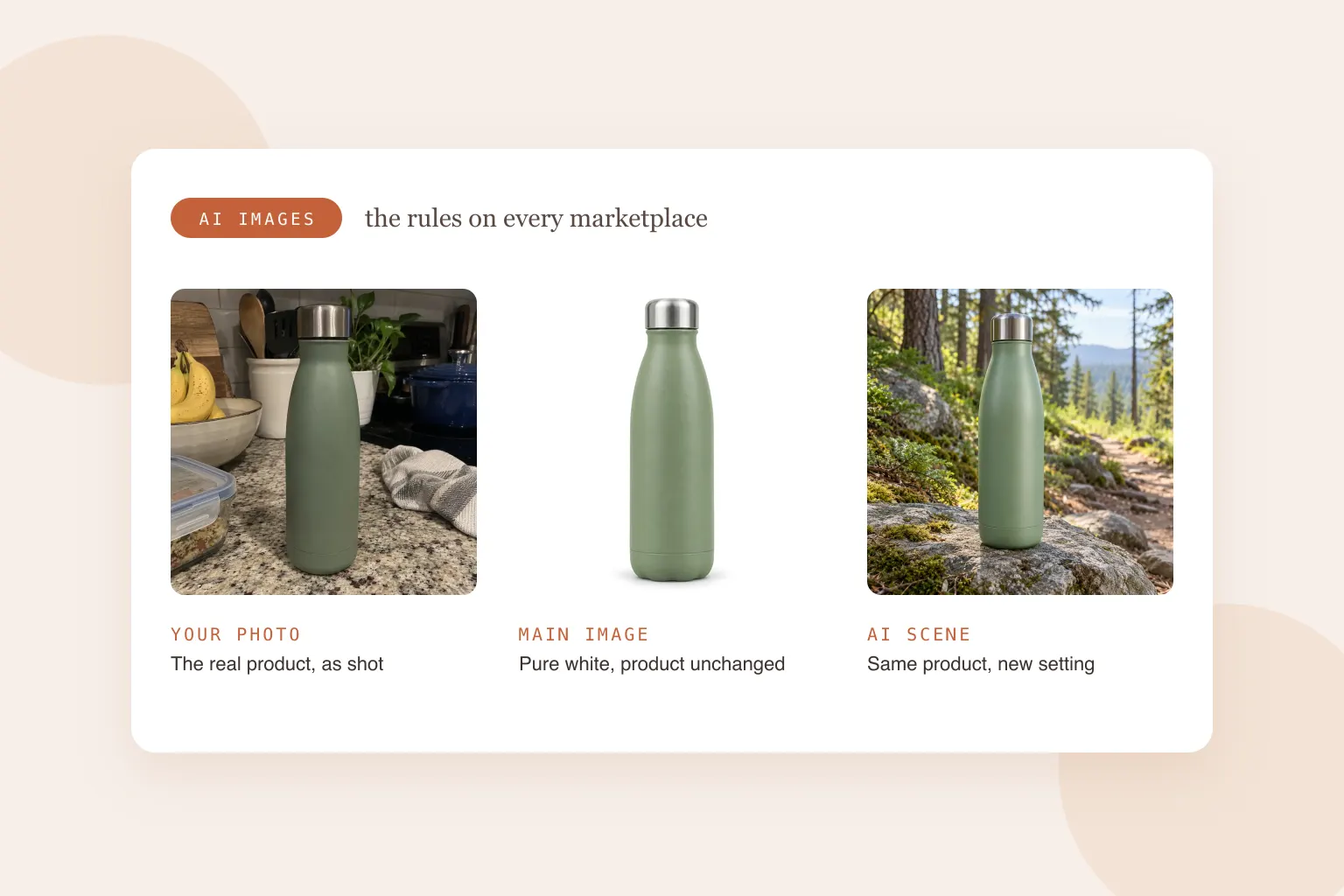
Short answer: yes, on every major marketplace, with one shared rule: the image has to show the product the buyer actually receives. Background swaps, lighting fixes and lifestyle scenes around your real product are allowed everywhere. Changing the product itself (its size, color, shape, features or quantity) is not allowed anywhere. The differences are in the details: Amazon's main image must be a real photo, Etsy now asks for at least one unedited photo on most listings, and Google Shopping wants AI images to keep the metadata that labels them as AI.
The question "can I use AI images on my listings?" used to get a shrug. In 2026 most platforms have written something down, and they agree more than they disagree. This page puts the rules side by side and links to our full guide for each one.
AI product image rules at a glance
- Marketplace
- Amazon
- AI images allowed?
- Yes, with limits
- Main image rule
- Must be a real photo of the product on pure white
- Disclosure
- Safer to disclose substantially AI-made lifestyle scenes
- Marketplace
- Etsy
- AI images allowed?
- Yes, in most photos
- Main image rule
- At least one unedited photo of the real item on most listings (from Oct 2026)
- Disclosure
- Required if AI created the item itself
- Marketplace
- eBay
- AI images allowed?
- Yes
- Main image rule
- Must accurately show the item; real photos for used items
- Disclosure
- No AI-specific rule
- Marketplace
- Walmart
- AI images allowed?
- Yes
- Main image rule
- Seamless white, real product
- Disclosure
- No disclosure required
- Marketplace
- TikTok Shop
- AI images allowed?
- Yes
- Main image rule
- Must match the real product and SKU
- Disclosure
- Accuracy rule, not a labeling rule
- Marketplace
- Google Shopping
- AI images allowed?
- Yes
- Main image rule
- Clean view of the real product
- Disclosure
- AI images must keep their AI metadata
- Marketplace
- Shopify
- AI images allowed?
- Your own store
- Main image rule
- No platform rule
- Disclosure
- Truth-in-advertising law applies
Rules were checked against each platform's published guidance in October 2026. Policies change, so check the platform's own help pages before a big launch.
The one rule every platform shares
Every policy below comes back to the same idea: the buyer should receive what the image shows. That gives you a simple test for any AI image:
- Allowed everywhere: a clean or new background, better lighting, a lifestyle scene built around a real photo of your product, a styled flat lay, an infographic.
- Not allowed anywhere: a different color, size, shape or material than the real item; features or accessories that don't come in the box; hiding defects; a product you haven't made yet shown as if it exists.
If you start from a real photo of your real product and only change what's around it, you're inside every platform's rules.
Amazon
Amazon allows AI for backgrounds, lighting and lifestyle scenes, but the main image, the one in search results, must be a true photographic representation on a pure white background (RGB 255, 255, 255) with the product filling about 85% of the frame. Secondary images have more room for AI scenes and infographics.
Amazon treats AI use as a spectrum. Editing a real photo is AI-assisted and needs no note. A fully AI-generated lifestyle scene sits closer to AI-generated, and adding a short disclosure in the description is the safer call. Full details: AI images on Amazon listings and Amazon product image requirements.
Etsy
Etsy changed its rules on October 22, 2026. According to coverage of the update, most listings now need at least one unedited photograph of the actual item against a real background: no cropping, resizing, lighting changes or background swaps on that one photo. Your other photos can still be edited, including with AI, as long as they accurately show what the buyer receives. Pattern, recipe and seed listings need at least one real photo of a finished result.
Separately, Etsy's Creativity Standards ask sellers to disclose in the listing when an item itself was created with AI. Using AI only to edit your photos is a different case, and disclosure there is a judgment call. Check Etsy's Seller Handbook announcement for the exact wording, since this policy is days old. For sizes and crops, see Etsy listing photo size.
eBay
eBay has no separate AI image rule. Its picture policy requires that photos accurately show the item, and it bans borders, added text, watermarks and placeholder images. Used, damaged or defective items need photos of the actual item, not stock or catalog images.
eBay also offers its own AI tools in the app that remove backgrounds and generate scenes, and suggests using generated scenes for only a few of your photos. Full details: eBay picture requirements.
Walmart
Walmart allows AI images as long as they are accurate, truthful and not misleading, and you have the rights to them. There is no ban and no disclosure requirement. The main image goes on a seamless white background and has to show the real product. Stock photos are not allowed. Full details: Walmart product image requirements.
TikTok Shop
TikTok Shop published its AI image requirements in September 2026. The policy says the goal is not to discourage AI content but to stop misleading product displays. It lists what's ruled out: changing a product's size, color, shape, material, features or quantity, exaggerated scale, and images that don't match the listing attributes or SKU. It is an accuracy rule rather than a labeling rule. Full details: AI images on TikTok Shop.
Google Shopping
Google Merchant Center allows AI-generated product images with one technical requirement: they must keep the IPTC metadata that marks them as AI-made, such as the DigitalSourceType value TrainedAlgorithmicMedia. Image compressors and some CDNs strip that metadata without telling you, so check the files your feed actually points to. The usual image rules still apply: no promotional overlays, watermarks or added logos. Full details: Google Shopping image requirements.
Shopify
Shopify is your own store, not a marketplace, so there's no listing review and no AI image policy for merchants. Shopify's acceptable use policy bans defrauding buyers, and its own AI media tool only changes the background around a product, not the product itself. In the US, the FTC's truth-in-advertising rules apply to product images in any medium, AI or not. Full details: Shopify product image size.
Running ads with AI images
If the same images run as Meta ads, Meta labels ads with "AI info" when they were made or materially edited with Meta's own generative AI features, like background generation. Images made with other AI tools won't necessarily get the label. Required disclosure only applies to social issue, election and political ads.
How to stay safe on every platform
- Start from a real photo of the real product. Let AI change the scene, not the product.
- Keep the main image real and clean. White background on Amazon and Walmart, and one unedited photo on Etsy.
- Check color and details against the item in your hand before you upload.
- Keep a simple log of which listing images used AI, and how. If a platform asks, it's a one-email answer.
- Disclose when in doubt. A one-line note in the description costs nothing.
BrandShots is built around this: it starts from your product photo, keeps the product as photographed, and changes only the background, lighting and scene around it.
Are AI-generated product images allowed on Amazon?
Yes, with limits. AI backgrounds, lighting and lifestyle scenes around your real product are allowed. The main image must be a true photo of the product on pure white, and the product can't be changed or misrepresented.
Does Etsy allow AI product photos?
Yes, but since October 22, 2026 most listings need at least one unedited photo of the real item against a real background. Other photos can use AI if they accurately show what the buyer receives.
Do I have to disclose AI-generated product images?
It depends on the platform. Google Shopping requires AI images to keep their AI metadata. Etsy requires disclosure when the item itself was made with AI. Amazon, Walmart, eBay and TikTok Shop focus on accuracy rather than labels, though disclosing substantially AI-made scenes is the safer habit.
Can AI change how my product looks in the photo?
No, on any platform. Changing the color, size, shape, material or features of the product is what every policy rules out. Use AI for the background, light and scene only.
Common mistakes
- An AI render as the Amazon main image. Slot 1 has to be a real photo on white.
- No unedited photo on Etsy. Since October 2026, most listings need one.
- AI color "corrections" that change the product. If the real item is cream, the photo can't be white.
- Stripping AI metadata when compressing images for Google Shopping.
- Scale tricks. Props or angles that make a product look bigger than it is break TikTok Shop's rules, and confuse buyers everywhere else.